

A standard medical note describing "memory issues" or "brain fog" is often the primary reason disability claims are denied. While your symptoms are very real, the system demands more than a general diagnosis; it requires a precise map of how your brain functions in the real world. You might feel a deep sense of anxiety that your evidence isn't objective enough to prove your limitations, especially when a standard doctor visit only lasts fifteen minutes. It's frustrating to feel like your future depends on paperwork that doesn't capture the full scope of your daily struggle.
Undergoing a neuropsychological evaluation for disability shifts the focus from subjective complaints to empirical data. This guide explains how specialized cognitive testing provides the objective evidence required to support your claim and clarify your functional limitations with scientific rigor. You'll learn exactly what to expect during the assessment process, how these tests differ from routine medical exams, and how to find a qualified expert in the DFW metroplex to help you move from uncertainty to informed action.
Key Takeaways
- Understand how a comprehensive assessment of brain-behavior relationships provides the functional data that standard medical imaging often fails to capture.
- Discover how a specialized neuropsychological evaluation for disability identifies specific cognitive deficits that directly impair your ability to maintain consistent employment.
- Learn how objective data maps to Social Security Administration (SSA) criteria and supports the development of an accurate Residual Functional Capacity assessment.
- Prepare for your diagnostic appointment by organizing essential medical, school, and work records to ensure a thorough clinical review.
- Find out how to access expert diagnostic testing in the DFW metroplex to move from claim uncertainty to scientific clarity.
What is a Neuropsychological Evaluation for Disability Claims?
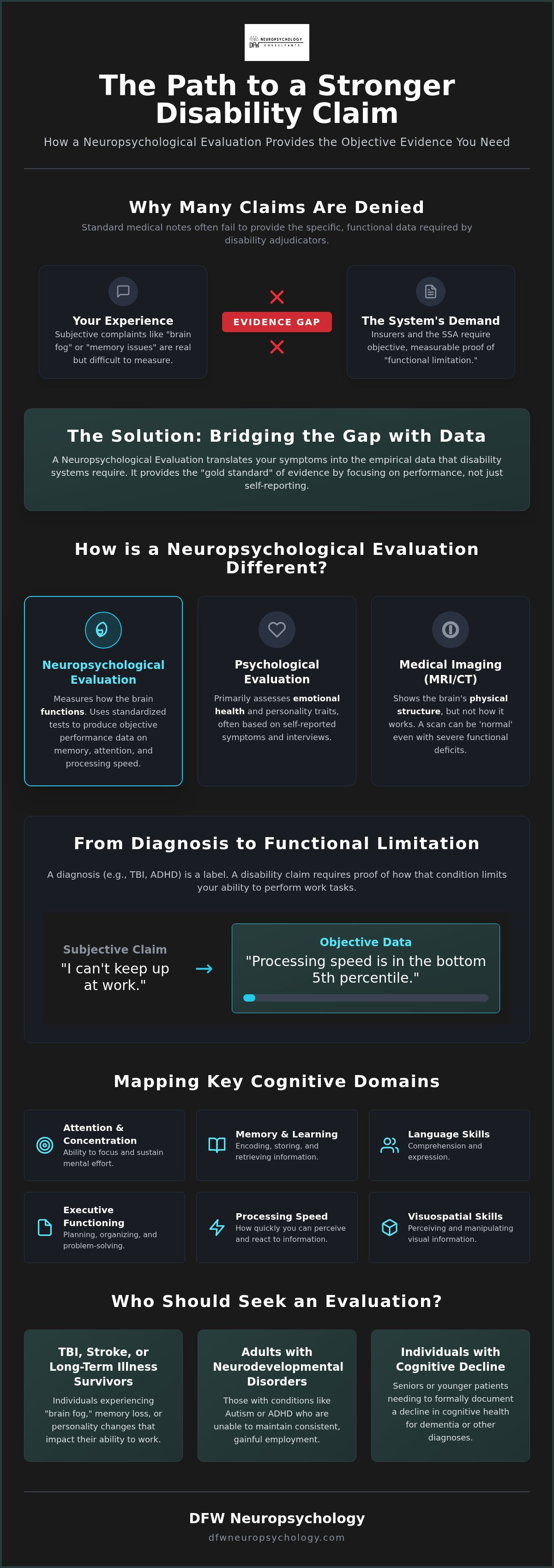
A neuropsychological evaluation is a comprehensive assessment of brain-behavior relationships. It's much more than a standard mental health checkup. This specialized process uses standardized tests to measure how well your brain actually functions in areas like memory, attention, language, and executive processing. While a psychiatrist might focus on mood and a neurologist might focus on physical nerves, a neuropsychologist looks at the intersection of the two. They act as objective medical experts who translate complex cognitive data into a clear picture of your daily capabilities.
One common point of confusion is the difference between a standard "psychological" evaluation and a neuropsychological one. A psychological exam primarily assesses emotional health and personality traits. In contrast, a neuropsychological evaluation for disability focuses on the mechanics of thinking. It provides the "gold standard" of evidence because it's based on performance data rather than just a patient's self-reported symptoms. This distinction is vital when you're trying to prove a cognitive impairment to an insurance company or the government.
It's also important to understand why standard medical imaging, such as an MRI or CT scan, often fails to support a disability claim. These scans show the structure of the brain, but they don't show how it works. You can have a "normal" looking MRI after a traumatic brain injury and still suffer from profound deficits in focus or memory that make employment impossible. Testing fills this gap by documenting functional disability that a camera simply cannot see.
The Difference Between Diagnosis and Functional Limitation
A diagnosis is just a label. For the Social Security Administration (SSA) or private insurers, having a diagnosis like ADHD, Depression, or even Early-Onset Alzheimer's isn't enough to qualify for benefits. They require proof of "functional limitation." This means you must show exactly how your symptoms prevent you from performing work tasks. Testing demonstrates the severity of your symptoms in a controlled environment. It provides objective data that replaces subjective claims, showing, for example, that your processing speed is in the bottom 5th percentile, making it impossible to keep up with a standard work pace.
Who Should Seek an Evaluation for Disability?
This type of assessment is essential for anyone whose ability to earn a living is compromised by cognitive or neurological issues. This includes:
- Individuals experiencing "brain fog," persistent memory loss, or personality changes following a TBI, stroke, or long-term illness.
- Adults with neurodevelopmental disorders, such as autism or ADHD, who find they cannot maintain gainful employment despite their best efforts.
- Seniors or younger patients who need dementia diagnostic testing DFW to confirm a decline in cognitive health.
By undergoing a neuropsychological evaluation for disability, you're building a foundation of scientific evidence. This clarity helps your legal team and medical providers speak the same language as the disability adjudicators, significantly reducing the risk of a denial based on lack of evidence.
Measuring Functional Impact: Cognitive Domains and Testing Methods
To determine if an individual qualifies for benefits, a neuropsychologist utilizes a "battery" of tests. This isn't a single exam, but rather a structured series of standardized assessments designed to create a comprehensive profile of your brain's capabilities. By comparing your performance against normative data from healthy individuals of the same age and education level, the evaluator can pinpoint specific deficits that impair daily functioning. This objective approach removes the guesswork from the disability process, providing a clear map of what you can and cannot do in a professional environment.
A critical component of a neuropsychological evaluation for disability is validity testing. These specific measures are embedded throughout the assessment to ensure the results are accurate and defensible. They verify that the patient is providing their best effort and that the data truly reflects their cognitive status. For a disability claim to be successful, the evidence must be beyond reproach; validity testing provides the scientific foundation that makes your report difficult for insurance adjusters or the Social Security Administration to dismiss.
Consistency is paramount in these evaluations. Using a standardized approach is required for clinical diagnostic testing for brain function to ensure that every result is reliable. This methodical process allows the neuropsychologist to identify not just the presence of a condition, but its specific impact on your life. If you are struggling to maintain your career due to cognitive changes, you can schedule a consultation to begin the process of documenting your functional limitations.
Key Cognitive Domains Evaluated
The evaluation focuses on several "domains" that are essential for most jobs. Executive functioning is often the most critical; it involves your ability to plan, organize, and multitask. If you cannot sequence tasks or manage your time, you'll likely struggle in any modern workplace. Attention and processing speed are also measured to see if you can keep up with the typical pace of a workday. Finally, memory and learning tests determine if you can retain new instructions or recall vital information under pressure, which are fundamental requirements for gainful employment.
Psychological and Emotional Factors
Cognitive performance doesn't exist in a vacuum. Emotional states such as depression, anxiety, and OCD can significantly mimic or worsen cognitive deficits. A comprehensive report includes an objective measurement of these mood disorders to rule out or confirm them as primary disabling factors. By integrating personality testing and emotional screening, the neuropsychologist provides a holistic view of your health. This ensures that the final report isn't just a list of scores, but a narrative that explains how your emotional and cognitive health interact to prevent you from working.
Bridging the Gap: How Objective Data Supports SSDI and Private Claims
The transition from clinical results to a successful claim requires translating raw data into the specific language used by adjudicators. The Social Security Administration (SSA) utilizes a manual known as the "Blue Book" to list specific impairments that qualify for benefits. A neuropsychological evaluation for disability is uniquely suited to address these listings. It provides the granular data required to meet specific criteria for neurocognitive disorders, mood disorders, or intellectual disabilities. By mapping cognitive scores directly to these listings, the neuropsychologist provides a clear, evidence-based argument that simplifies the examiner’s decision-making process.
One of the most critical elements of any claim is the Residual Functional Capacity (RFC) assessment. This document outlines what an individual can still do despite their limitations. While many medical records are vague about work-related tasks, a neuropsychological report provides a detailed narrative. It specifies, for instance, exactly how many minutes a patient can maintain focus before needing a break or how their memory deficits prevent them from following multi-step instructions. This level of detail bridges the gap between a medical diagnosis and the practical realities of a workplace; it transforms abstract symptoms into measurable work-related impairments.
If an initial claim is denied, these evaluations become even more vital during the appeals process or at a hearing before an Administrative Law Judge. The objective nature of the testing helps to counter the common "lack of evidence" justification for denials. It provides a scientific foundation that allows your legal representative to point to specific, standardized deficits rather than relying solely on your personal testimony. This shift from subjective experience to objective proof is often the turning point in complex cases.
Social Security Disability Insurance (SSDI) Requirements
To be considered valid by the SSA, evidence must come from "Acceptable Medical Sources" (AMS). Licensed neuropsychologists are recognized as such, lending their reports significant weight during the review process. Testing also helps address the "grid rules," which are used to determine disability based on age, education, and work experience. By providing objective cognitive scores, the evaluation can demonstrate that an individual’s "non-exertional" limitations, such as impaired processing speed or executive dysfunction, are severe enough to preclude even sedentary work. Establishing this baseline early creates a longitudinal record that demonstrates the persistence of the condition over time.
Private Long-Term Disability (LTD) and ERISA
Navigating private insurance claims often involves meeting the "preponderance of evidence" standard. Private carriers frequently look for any reason to deny a claim, often relying on their own contracted reviewers who never meet the patient. Providing a comprehensive neuropsychological evaluation for disability early in the process is critical. It establishes a strong baseline of evidence before an insurer-ordered examination can take place. For claims governed by ERISA, having this objective data in the administrative record is essential. It ensures that if a denial occurs, the appeal is supported by rigorous scientific data that is difficult to overlook in a court of law.
The Evaluation Process: Preparing for Your Diagnostic Appointment
Preparation for your appointment begins long before you walk through the clinic doors. Gathering your records is the first essential step. Ensuring that the neuropsychologist has access to your full medical, educational, and vocational history allows for a more nuanced interpretation of your current cognitive state. You should prepare a comprehensive list of all current medications, including dosages, as many prescriptions can influence cognitive performance. If you have previous school records or performance reviews from past employers, these documents provide vital baseline data that helps the doctor understand your professional trajectory and where it began to shift.
The structure of the day is methodical and thorough. Most appointments begin with a detailed clinical interview where you can discuss your symptoms, history, and the specific challenges you face. Following this, you will engage in several hours of standardized testing. While the length of a neuropsychological evaluation for disability might feel daunting, the duration itself serves as a critical data point. In a standard work environment, you are expected to perform for eight hours. By observing how your focus, accuracy, and processing speed fluctuate over several hours of testing, the doctor can objectively document how fatigue impacts your functional capacity.
To ensure your results are defensible, it is vital to provide an honest and effortful performance. The tests are designed to be challenging; they are meant to push your cognitive limits to see where they currently lie. Trying your best on every task, even when it feels difficult, ensures that the resulting data is a true reflection of your abilities. This integrity makes the final report a powerful tool in your disability claim. If you are ready to begin this process, you can request an appointment at one of our DFW locations to secure your evaluation date.
What to Expect During Testing
The testing phase involves a variety of tasks that measure different aspects of brain function. You might solve puzzles, provide verbal responses to specific questions, or complete assessments on a computer. Many of these tasks are administered by a psychometrist. This is a trained clinical professional who works under the doctor's supervision to ensure every test is given in a standardized way. It is important to remember that there are no "pass or fail" scores. The goal is simply to identify your unique cognitive profile, including both your strengths and the deficits that may be hindering your ability to work.
After the Evaluation: The Results and Report
Once the testing is complete, the process of scoring and interpretation begins. This is a complex stage where the neuropsychologist analyzes hundreds of data points to create a cohesive narrative of your cognitive health. This typically takes one to two weeks to finalize. After the data is synthesized, you will participate in a feedback session to review the findings. This meeting is an opportunity to understand your cognitive profile and discuss the recommendations for your care. The final, formal report is then delivered directly to your attorney or disability caseworker to serve as objective evidence for your claim.
Expert Diagnostic Testing in the DFW Metroplex
DFW Neuropsychology, led by Dr. Mathew, offers a specialized clinical environment dedicated to diagnostic precision and scientific objectivity. Our approach focuses on providing the objective data necessary to navigate complex medical and legal situations with confidence. We don't provide long-term therapy or medication management. Instead, we concentrate on delivering the "gold standard" of diagnostic evidence through rigorous testing. By serving the entire DFW metroplex, including Irving, Dallas, Fort Worth, Keller, and Arlington, we ensure that patients have access to expert care close to home.
Our clinic's focus remains steadfast on high-quality, objective diagnostic evaluations. We understand that the disability process is often fraught with stress and uncertainty. To mitigate this, we provide a structured and methodical assessment process that prioritizes accuracy and professional integrity. Whether you're dealing with the aftermath of a neurological event or managing a lifelong developmental disorder, our goal is to provide the clarity you need to make critical life decisions. Scheduling a neuropsychological evaluation for disability is a proactive step toward documenting your functional reality in a way that adjudicators can respect and verify.
Why Choose a Local DFW Specialist?
Selecting a local expert provides several practical advantages for patients and their families. Our team maintains deep familiarity with North Texas medical networks and referral patterns, which can streamline the coordination of your care. For residents in Flower Mound, Southlake, and Grand Prairie, our multiple office locations offer convenient access to high-level testing without the need for extensive travel. Each of our clinics is designed to be a professional, clinical environment that prioritizes patient comfort and clarity throughout the intensive testing process. This local presence allows us to act as a scientific partner for families across the metroplex.
Next Steps for Your Disability Application
If you're currently navigating the disability process, the first step is often to consult with your disability attorney about the specific evidentiary needs of your case. They can help determine if specialized testing is required to address gaps in your medical record. Once the need is established, contacting DFW Neuropsychology for a diagnostic consultation is the most effective way to begin. A neuropsychological evaluation for disability provides the empirical evidence needed to move your claim forward with scientific rigor. By choosing a dedicated specialist, you're taking a significant step toward achieving both diagnostic and financial clarity. It's about moving from a place of uncertainty to a position of informed action, ensuring your cognitive profile is documented with the precision it deserves.
Securing Your Path to Diagnostic Clarity
Navigating the disability claim process requires more than a standard medical diagnosis; it demands a precise, data-driven map of your cognitive landscape. By focusing on objective functional limitations rather than subjective reports, you provide adjudicators with the scientific evidence they require. A specialized neuropsychological evaluation for disability transforms your lived experience into a defensible narrative of brain-behavior relationships, ensuring that your cognitive deficits are clearly documented and verified.
At DFW Neuropsychology, our team is led by a Licensed Clinical Neuropsychologist dedicated to providing diagnostic clarity for complex cases including ADHD, Autism, and Dementia. We provide comprehensive reports designed to support your journey toward health and financial stability, serving patients across the entire Dallas-Fort Worth Metroplex. You don't have to face the complexities of the disability system without the support of objective data.
Take the next step toward a clear understanding of your cognitive health. Schedule Your Diagnostic Evaluation with DFW Neuropsychology today. We are here to act as your scientific partner, helping you move from uncertainty to informed action with confidence and optimism.
Frequently Asked Questions
How much does a neuropsychological evaluation for disability cost?
The cost of an assessment depends on the specific battery of tests required to document your functional limitations. Since every diagnostic profile is unique, fees are calculated based on the time spent in the clinical interview, testing administration, and the complex process of data interpretation and report preparation. It's best to contact our office directly to discuss the specifics of your case and receive a detailed estimate for your evaluation.
How long does the disability neuropsychological testing take?
A comprehensive evaluation typically requires four to eight hours to complete in a single day. This timeframe includes the initial clinical interview and several hours of standardized, face-to-face testing. We can break the session into manageable segments if fatigue becomes a significant factor for the patient. This length is necessary to gather enough objective data to build a defensible profile for your disability claim.
Can a neuropsychological evaluation hurt my disability claim?
An evaluation provides an objective, scientific record of your cognitive status based on standardized performance data. While the goal is to provide evidence for a claim, the results reflect your actual cognitive functioning at the time of testing. If the data shows your functioning is within normal limits, it may not support a claim for total disability. However, this information remains valuable for diagnostic clarity and informing your future medical care.
What is the difference between a neuropsychological and a psychological evaluation?
The primary difference lies in the specific cognitive domains being measured. A psychological evaluation assesses emotional health, personality traits, and mood disorders. In contrast, a neuropsychological evaluation for disability measures the mechanics of thinking, such as memory, attention, and executive function. While both are important, the neuropsychological exam provides the specific functional data required to prove cognitive work-related limitations to adjudicators.
Do I need a referral for a neuropsychological evaluation in Texas?
You don't legally need a physician's referral to schedule a private evaluation in Texas. However, many insurance providers require a referral from a primary care doctor or neurologist to consider the service a covered medical necessity. If you're working with a disability attorney, they may also recommend an evaluation to strengthen your administrative record regardless of whether you have a formal medical referral from another doctor.
Will my health insurance cover testing for a disability claim?
Health insurance often covers testing when it's deemed medically necessary to diagnose a condition like dementia or a traumatic brain injury. However, some policies specifically exclude evaluations that are performed solely for legal purposes or insurance claims. It's important to verify your specific benefits with your carrier to understand your out-of-pocket responsibilities before your appointment. Our staff can help you navigate these insurance questions during the intake process.
How does the SSA view neuropsychological test results?
The Social Security Administration (SSA) views these evaluations as highly credible, objective medical evidence. Because the tests are standardized and include validity measures to ensure effort, they carry significant weight with disability adjudicators. The reports provide the "Acceptable Medical Source" data that the SSA uses to determine if your impairments meet their specific listings or significantly impact your Residual Functional Capacity for work.
What happens if my results are 'mild' but I still can't work?
Even results categorized as "mild" in a clinical sense can be disabling depending on the demands of your specific profession. A mild deficit in processing speed might not impact simple daily tasks, but it could make high-level executive work or safety-sensitive jobs impossible to perform. The final report will explain how these specific deficits interact with your unique job requirements to demonstrate why you're unable to maintain gainful employment.


